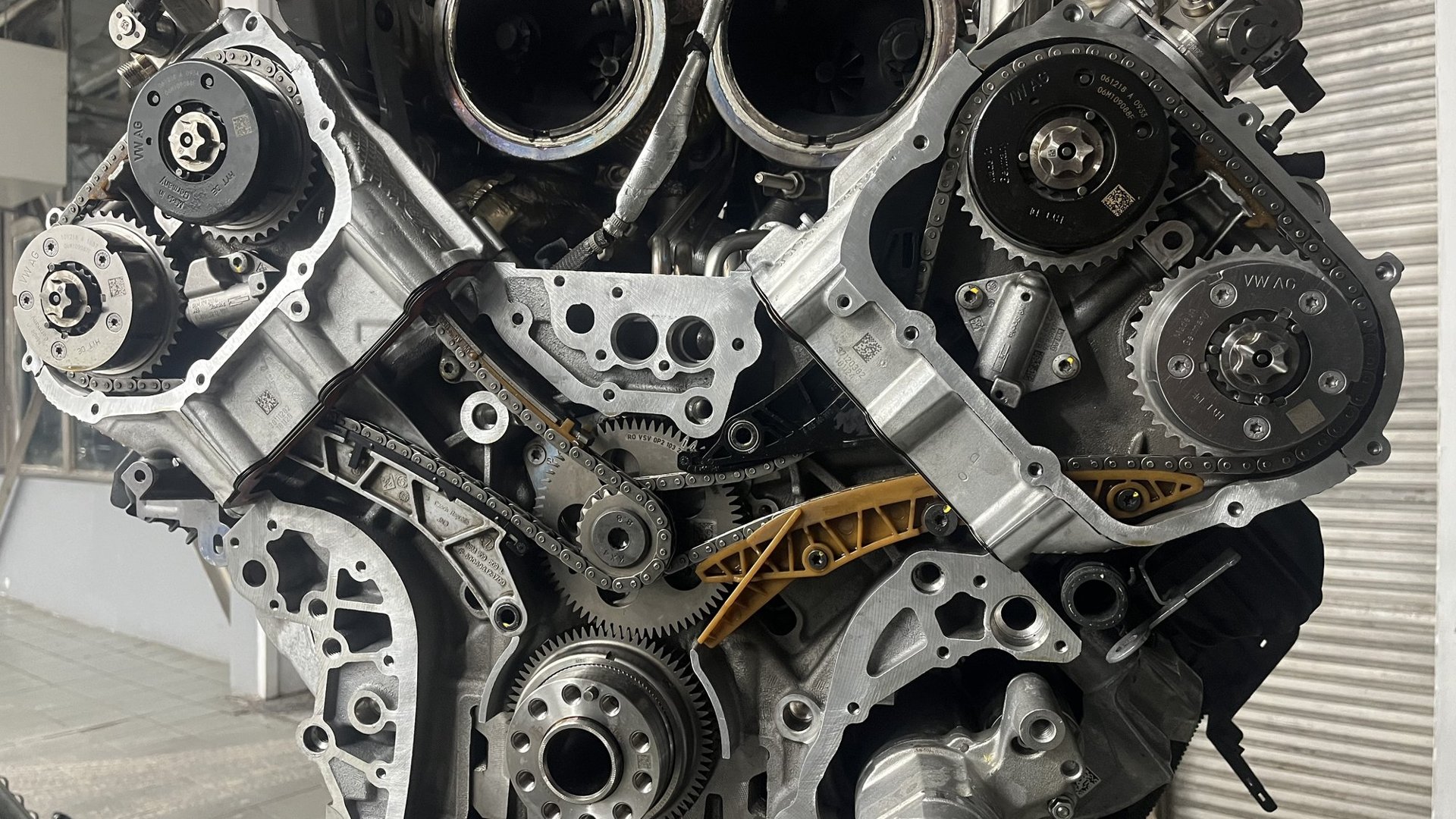
The Audi 4.2 FSI timing chain problems are something I want you to know about if you own one of these V8s. You'll know the 4.2 V8 FSI from the RS4 B7, R8, S5, A6, A8 and Q7. It sounds incredible, keeps pulling right up to the top of the rev range, and it's one of the reasons we love Audi. But there's something important about this engine I want you to understand. The timing chains sit at the back, right next to the gearbox. And that's where the big problem starts.
Why are Audi 4.2 FSI timing chain problems so expensive to fix?
On most engines, the timing gear is at the front, where it's relatively easy to reach. On the 4.2 FSI, though, the chains are tucked away between the engine and the gearbox. To replace them, we have to take the entire engine out. That makes the job expensive, which is why I always tell you to plan ahead. Don't wait for a chain to give up. Because if that happens, you're looking at a very different repair bill.
What actually wears out in the timing chain system?
- Chain guides and tensioners — the plastic guides gradually wear down over the years, and sometimes they even break.
- The timing chains themselves — they gradually stretch, throwing the timing between the camshafts and crankshaft out of sync.
- Hydraulic tensioners — old engine oil stops them working properly and keeping the chains at the right tension.
How can you tell if your timing chains are going bad?
- You hear that telltale rattling noise from the back of the engine when you start it cold.
- The check engine warning light comes on, and diagnostics show camshaft timing deviation fault codes.
- The engine runs unevenly, doesn't pull like it used to, and you can feel it's losing power.
How do we check whether the timing chains are worn?
At Das Auto Service, we start with diagnostics. We check how far the camshaft timing has deviated relative to the crankshaft. Those readings tell us how much the chains have stretched, even if they haven't started rattling yet. That way, we can tell you whether the repair is already urgent or whether you've still got time to plan it properly. Don't wait for the engine to start telling you something's wrong.
If your 4.2 FSI is showing camshaft timing correlation faults, don't keep driving it. If a chain jumps a tooth or a guide breaks, the valves can hit the pistons. And then the repair becomes many times more expensive. I'm telling you this because, at the end of the day, that bill comes out of your own pocket.
How can you help your timing chains last longer?
- Change the engine oil and oil filter every 10,000 km or once a year, whichever comes first, and always use oil that meets the engine's required specification. Old oil is one of the quickest ways to ruin the tensioners.
- Don't rev the engine hard while it's still cold.
- Have the timing chain readings checked with diagnostics at every service. That way, you'll catch a problem before it turns into something serious.
There's one more thing I want you to know about this engine. Because it uses direct injection, carbon builds up on the intake valves. If we've already taken the engine out to replace the timing chains, it makes sense to clean those valves as well. That saves us having to go back and tackle them separately later.
A tip from Kris Mladenov: If you've got your eye on a car with the 4.2 FSI and you're thinking of buying it, make sure you ask for a diagnostic check of the timing chain readings. For me, that's the single most important check on this engine.
If you drive an Audi with the 4.2 V8 FSI, bring it to Das Auto Service and we'll check the timing chains with diagnostics. We'll see how they're doing and tell you whether it's time for a repair or whether you can safely plan it for later. I want you to know what's happening inside your engine while there's still time to do something about it, not when it's already too late.
The solution in our shop

Genuine LongLife III FE 0W30 engine oil, 5 litres
Genuine engine oil meeting the specification for the 4.2 FSI. Changing it regularly helps the hydraulic tensioners and timing chains last longer.
View in our shopRead more
- Complete engine rebuilds
- Diagnostics at Das Auto Service
- 3.0 TDI: why does the engine have to come out to replace the timing chains?
- Carbon build-up on TSI and TFSI valves: why it happens and how to clean it
- The torque wrench: why we tighten everything to the correct torque
- 4.0 TFSI V8 in the RS6 and S8: the turbos and servicing
Frequently asked questions
Why does the engine have to come out to replace the timing chains on the 4.2 FSI?
Because the chains are at the back of the engine, right between the engine and the gearbox. There's simply no other way to get to them.
How can I tell if my timing chains are worn?
We use diagnostics to check the camshaft timing deviation relative to the crankshaft. That lets us spot wear before you even hear that telltale rattle.
How often should I change the engine oil on my 4.2 FSI?
My advice is every 10,000 km or once a year, whichever comes first. Always use oil that meets the engine's required specification, and change the oil filter at the same time.