It's January, it's minus ten outside, and your dashboard suddenly shows something no diesel owner wants to see: "No engine start in 1000 km." If you've got a 2.0 TDI EA288, that AdBlue no start in 1000 km warning is enough to ruin your morning. Your first thought is that the car's going to leave you stranded on the motorway. Then you remember it might just be running low on AdBlue. And sometimes it really is that simple. But I've also seen cars with completely full AdBlue tanks where the countdown just keeps going. Why? Let me explain.
What is AdBlue, and why won't your car start without it?
Newer 2.0 TDI engines from the EA288 generation, found in cars like the Golf 7, Passat B8, A4 B9, Tiguan 2, Octavia 3 and Superb 3, have a system that reduces harmful nitrogen oxides in the exhaust gases. AdBlue is a mixture of urea and water that your car injects into the exhaust before the catalytic converter. By law, the car isn't allowed to operate without this system working properly. So if you run out of AdBlue or something breaks, the car starts counting down the remaining kilometres. Once that countdown reaches zero, it won't let you start the engine. And trust me, that warning isn't there just to look pretty.
What if you've simply run out of AdBlue?
That's the easy one, and I really hope it's what's happened to your car. You'll normally start getting warnings when you've got around 2,400 km left. Just top up the AdBlue through the filler next to your fuel cap, usually the one with the blue cap, and the warning should disappear after a little while. But please, don't pour water or any other substitute in there. And try not to spill it either. AdBlue leaves white crystals behind and can damage paintwork and aluminium.
Only use AdBlue that meets the ISO 22241 standard. If you pour in water or some poor-quality substitute, you could ruin the AdBlue injector, the pump and the catalytic converter. And believe me, none of those parts are cheap.
Your AdBlue tank is full, but the countdown keeps dropping?
Right, now we've got a problem. On the EA288, the AdBlue tank itself is often the culprit. Inside it, there's a pump, a level sensor and a heater, all built into one unit. AdBlue freezes at around -11°C, so the heater needs to thaw it out when it's cold. If that heater fails, winter can become a real headache. The system can't deliver the AdBlue it needs, and the car logs a fault.
When we plug in our diagnostic equipment, these are some of the fault codes we see most often:
- P20B9 – AdBlue heater electrical circuit fault
- P20E8 – AdBlue pressure too low
- P207F – AdBlue quality not within specification
But don't go blaming the tank just yet. The AdBlue injector in the exhaust might be blocked with crystals, the NOx sensor (which measures nitrogen oxides) might have failed, or there could be a wiring problem. That's why, at Das Auto Service, we start by checking the live diagnostic data to find out what's actually wrong. We're not going to replace an entire AdBlue tank just because the dashboard says AdBlue.
How do we fix an AdBlue system fault?
- If the heater or pump has failed, we replace the unit inside the tank or the complete tank, depending on how that particular model is built.
- If the AdBlue injector is blocked with crystals, we clean it or replace it.
- If the NOx sensor has failed, we replace it and carry out the necessary adaptation.
- Once the repair is done, we clear the fault codes and reset the countdown.
Can't I just remove the AdBlue system?
I'll tell you exactly what I say about removing the DPF or the EGR: no. Your car becomes illegal to drive on public roads, you lose your warranty on newer models, and the original fault is still there. All you've done is hide it. And that, my friend, isn't a repair.
A tip from Kris Mladenov: If you see an AdBlue warning, don't wait for the countdown to reach zero. Run out of fluid? Top it up. Tank full but the warning won't disappear? Bring the car in straight away and let's find out what's wrong. A thousand kilometres sounds like plenty. Until they're gone and your car refuses to start right outside your own house.
I hope you now have a better idea of what your car is trying to tell you, so you won't panic the next time you see that warning. The important thing is to work out whether it simply needs more AdBlue or whether something has actually failed. And if I've helped you understand it, send this article to a friend who drives a newer diesel. You might save them a lot of headaches.
The solution in our shop
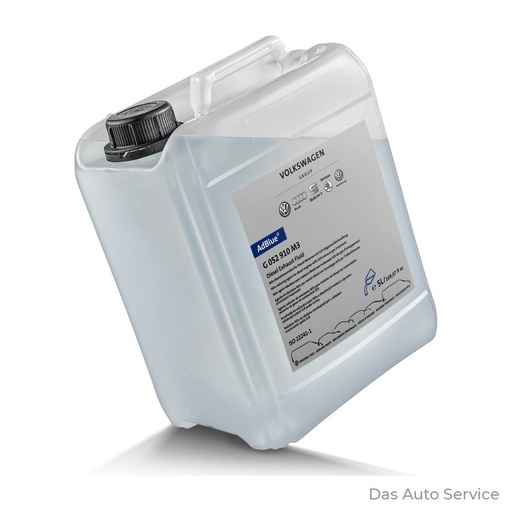
Genuine VAG AdBlue® fluid G052910M4 10 l
Genuine VAG AdBlue, 10 litres, meeting the ISO 22241 standard. Suitable for VAG diesel vehicles fitted with an AdBlue tank.
View in our shopRead more
- Vehicle diagnostics at Das Auto Service
- Electrical faults and control modules
- What do you need to know about the DPF?
- 2.0 TDI (EA189): EGR, cooler and limp mode
- TDI hard to start when cold: glow plugs and checks
- VW Passat B8 2.0 TDI service schedule
- Audi A4 B9 2.0 TDI service schedule
Frequently asked questions
What should I do if my car says "No engine start in 1000 km"?
First, check your AdBlue level. If it's empty, top it up. If the tank is full but the warning won't go away, something in the system isn't working properly. That's when you need a diagnostic check.
At what temperature does AdBlue freeze?
At around -11°C. That's why the tank has a heater to thaw the fluid when it's cold outside.
Can I top up with water instead of AdBlue?
No, my friend. Only use AdBlue that meets the ISO 22241 standard. Water can damage some very expensive parts of the system.