How can I check whether my engine oil and filters have actually been changed?

▶ The garage takes your money, but does it actually change the oil and filters? Check for yourself!
You pay for an oil and filter change, collect your invoice and drive away happy. But how do you know everything you've paid for has actually been replaced? The truth is, you don't know unless you check. That's why I'm starting a new series showing you how to check the work a garage has done on your car. I'll start with the 1.8 and 2.0 TFSI engines on the MQB platform – Golf 7, Octavia 3, Leon 3 and Audi A3 8V. In the video, I'll show you everything on the car itself. Here, I'll explain where to make a few small marks before you leave your car for a service.
Why should I check the garage's work in the first place?
Changing engine oil is one of the most routine jobs in any workshop. And precisely because it's so routine, some mechanics decide to cut a few corners. I'm not saying everyone cheats, and I certainly don't want you to be suspicious of every mechanic you meet. I simply want you to know how to check that you've got what you've paid for. All you need is a marker pen, your phone and a few minutes before the service. It's that simple.
How to check if your car oil was changed by draining rather than extracting it?
Do you know how easy it is to suck the old oil out through the dipstick tube? There's no need to remove the undertray, the car doesn't even have to go on a lift, and the job is done in no time. The problem is that sediment containing particles from engine wear can remain at the bottom of the sump. What's more, nobody gets a look underneath to check for leaks or inspect the condition of the suspension. And in the worst case, the oil hasn't been changed at all.
At our workshop, we drain the oil through the sump plug. Every time, we fit a new drain plug and tighten it with a torque wrench to the exact torque in Nm specified by the manufacturer. This isn't just us being fussy. A drain plug that's been removed and tightened repeatedly can eventually start leaking oil. Now I'll show you how to tell whether it's even been unscrewed.
- Before the service, make a small mark on the drain plug and extend it onto the sump next to it.
- If the plug has been unscrewed, the two marks will usually no longer line up.
- If the plug has been replaced with a new one, there won't be a mark on it at all.
- If the marks are still perfectly aligned, the plug probably hasn't been unscrewed.
IMPORTANT! If the marks are untouched, that's a very good reason to ask how the oil was changed. It may have been extracted through the dipstick tube, or it may not have been changed at all. The mark alone doesn't prove which of those things happened.
How can I tell whether the oil filter has been changed?
On the 1.8 and 2.0 TFSI engines, the oil filter sits inside a housing with a removable cap, which contains the filter element itself. To replace the filter, you have to unscrew that cap. There's no other way. And that's exactly what we'll use to check whether anyone has touched the filter. Nothing complicated.
- Use a permanent marker to make a small mark on the oil filter housing cap.
- Extend the mark onto the adjacent fixed part so you can compare the two lines afterwards.
- After the service, check whether the marks still line up. If the cap has been unscrewed, they'll usually no longer be aligned.
If the marks are still exactly where you left them, you've got good reason to question whether the cap was ever removed. Imagine paying for a new oil filter, only for the old one to stay in your engine for another 10,000 km. Not a nice thought, is it? That's why I'm showing you these things. So you don't have to rely entirely on what it says on the invoice.
How can I check whether the air filter has been replaced?
The air filter is one of the easiest service items to overlook. It's hidden inside its housing, so you can't see it from the outside. And when it becomes clogged, the engine struggles to breathe, the car may not pull as well as it should, and fuel consumption can increase. That's why we're going to mark not just the housing but the filter itself. That makes checking it much more straightforward.
- Make a small mark on the bolt and washer on the air filter housing.
- Open the housing and make a discreet mark between the pleats of the filter itself.
- After the service, inspect the filter. If the mark between the pleats is still there, you're looking at the old filter.
Where is the cabin filter and how do I mark it?
On cars built on the MQB platform, the cabin filter is located behind the glovebox. Open the glovebox and you'll see two buttons at the top. Press them and the glovebox will drop down. Behind it is a cover, with the filter itself underneath. Make a small mark on the side of the filter frame. Afterwards, it'll be easy to tell whether it's been replaced. If you'd like to learn more, read when to replace the cabin filter and what happens if you neglect it.
Just be careful with the plastic clips on the glovebox. Don't force it, because they're easy to break. There's no point creating another problem for yourself just to carry out a simple check.
What should I do if the marks haven't moved?
First of all, don't start an argument over the phone. Take your photos, go back to the garage and calmly ask exactly what was replaced and how the service was carried out. A decent workshop has no reason to avoid questions like these. They'll show you the old parts if they've kept them, or explain what they did. If they start giving you the runaround, you can draw your own conclusions. I've always said you can judge a garage by how it answers its customers' questions.
At our workshop, we change the engine oil and service filters every 10,000 km or once a year, whichever comes first. This applies to cars driven in Bulgaria, regardless of LongLife intervals. We drain the oil through the sump plug, fit a new drain plug and use genuine filters. And if you decide to check our work too, I've got absolutely no problem with that. In fact, I'd be pleased.
Which engine oil should I use in an MQB 1.8 or 2.0 TFSI?
The answer is simple – genuine engine oil that meets the specification required for your engine. For most of these engines, that's LongLife III. Don't choose your oil simply because the container says 5W-30 or 0W-30. If you're wondering why, read why we don't use supermarket 5W-30 engine oil and which LongLife III 0W-30 oil is right for your VW. You can also find out more about the oil change itself on our Routine Servicing.
Advice from Kris Mladenov: Mark everything beforehand and photograph the marks before leaving your car at the garage. Keep them small and discreet so only you know where they are. In the video, I've made my marks large so you can see them clearly. And remember, a mark that's moved shows that something has been disturbed, but it doesn't prove exactly what has been replaced.
I hope you've found this article useful! If you have, I'd appreciate you sharing it with a friend who also takes their car in for servicing. My mission has always been simple – when I know something, I want more people to know it too. Because the more you understand about your own car, the harder it is for someone to pull the wool over your eyes.
The solution in our shop

Genuine LongLife III FE 0W-30 engine oil, 5-litre container
Genuine LongLife III FE 0W-30 engine oil in a 5-litre container. Suitable for servicing 1.8 and 2.0 TFSI engines where this oil specification is required.
View in shop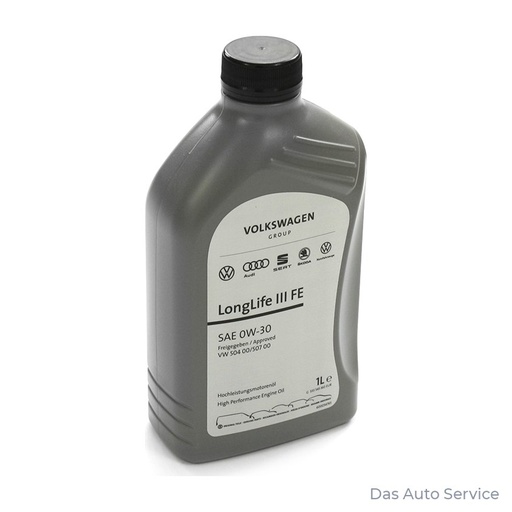
Genuine LongLife III FE 0W-30 engine oil, 1-litre container
Genuine LongLife III FE 0W-30 engine oil in a 1-litre container. Handy to keep in the car for topping up between oil changes.
View in shopFurther reading
- Routine Servicing
- Diagnostics
- Cabin Filter: When to Replace It and What Happens If You Don't
- LongLife III 0W-30 – Which Oil Is Right for Your VW?
- Supermarket 5W-30 Engine Oil – Why Don't We Use It?
Frequently asked questions
How can I check whether the garage changed my engine oil?
Before the service, mark the sump drain plug and the area next to it. If the marks have moved afterwards or the plug is new, someone has worked on it. If the marks are untouched, ask exactly how the oil was changed.
Is it bad to extract engine oil through the dipstick tube?
This method can leave sediment at the bottom of the sump. It also means missing the opportunity to inspect the underside of the car for leaks and check the condition of the suspension. That's why we drain the oil through the sump plug.
How can I check whether the oil filter was changed on a 2.0 TFSI?
Make a mark across the filter housing cap and the adjacent fixed part. If the cap has been unscrewed, the marks will usually no longer line up. If they still match, ask for an explanation.
How often should I change the engine oil and service filters?
At our workshop, we change the engine oil and service filters on cars driven in Bulgaria every 10,000 km or once a year, whichever comes first, regardless of LongLife intervals.