White smoke from diesel exhaust when warm is something a lot of owners search for when they notice their car smoking. I hear it at the workshop too: "Kris, it's fine in the morning, but once the engine warms up, it starts smoking. What's going on?" First, there's something important I want you to know. If you see white vapour coming from the exhaust on a cold morning, that's usually perfectly normal. But if the engine is already warm and there's still white smoke coming out of the back, we need to find out why. And no, it doesn't automatically mean your engine needs a major repair.
What are the signs of white smoke from diesel exhaust when warm?
The most obvious sign is white or greyish-white smoke coming from the exhaust even though the engine has reached its normal operating temperature. Sometimes the smoke has a strange, sweet smell. Other times, you might notice the coolant level in the expansion tank slowly dropping. You top it up, drive for a while, then check again and find it's gone down. That combination of white smoke and disappearing coolant is exactly what makes me take a very close look at the cooling system. Because coolant shouldn't just disappear.
How can I tell the difference between exhaust vapour and actual smoke?
This is the first thing I want us to establish, because plenty of people worry when there's absolutely nothing wrong. When it's cold outside, you might see white vapour coming from the exhaust, which gradually disappears as the engine and exhaust system warm up. That's normal. But if the car is already warm and there's still a white cloud hanging behind it, especially with a noticeable smell, that's a different story. It might smell sweet, like coolant, or more like unburnt diesel. And that's where the real diagnosis begins.
What causes a diesel engine to smoke white when it's warm?
There are quite a few possible causes, but there are a handful I always check first. The important thing is not to jump straight to the most expensive repair, because white smoke alone doesn't tell us which part has failed. We need to work out what's getting into the engine and why it isn't burning properly. Here's where I start.
- The EGR cooler is leaking coolant. EGR stands for exhaust gas recirculation. It's a system that sends some of the exhaust gases back into the engine, and its cooler uses engine coolant to bring their temperature down. When that cooler develops a leak, coolant can end up somewhere it shouldn't, causing white smoke. I've explained this in more detail in 2.0 TDI EA189: EGR and cooler.
- The head gasket is leaking. The head gasket seals the joint between the cylinder head and the engine block. If it stops sealing properly, coolant can get into the cylinders and come out of the exhaust as white smoke. This is a serious problem, but don't rush to blame the head gasket before we've carried out the necessary checks.
- An injector isn't spraying fuel properly. Diesel needs to enter the cylinder in a very particular spray pattern to burn efficiently. If an injector isn't spraying correctly, some of the fuel may remain unburnt, producing whitish smoke that smells of diesel. I've covered this in detail in my article about common rail injectors.
- DPF regeneration. This is when the diesel particulate filter burns off the soot that's built up inside it. During regeneration, you might briefly notice whiter smoke coming from the exhaust. That doesn't necessarily mean something is wrong. But if the smoke continues, don't automatically put it down to DPF regeneration. Have a look at my article about driving with a DPF in the city.
Why won't fuel additives fix the problem?
You'll often see people in online groups saying, "Just put some additive in the tank and it'll sort itself out." Right, but if your car is losing coolant, how exactly is an additive in the diesel going to seal a physical leak in the cooling system? It isn't. If the EGR cooler or head gasket is leaking, fuel quality isn't the problem. That's why I don't want you wasting money on products that have nothing to do with the actual fault. First we find the cause. Then we fix it.
How do we find out what's causing the white smoke?
At Das Auto Service, I don't start replacing parts based on guesswork. White smoke is a symptom, not a diagnosis. So we carry out a series of checks to establish whether we're dealing with a coolant problem or a fuel problem. The order matters, because there's no point taking an engine apart unless we have a good reason to.
- We check the coolant level. First, we need to establish whether the car is actually losing coolant or whether we're simply seeing white smoke without any coolant loss.
- We pressure-test the cooling system and check for gases in the coolant. This helps us look for signs of leaks and sealing problems.
- We check the injectors. We look at their correction values and how much fuel they're returning to see whether any of them aren't working properly.
- We inspect the EGR system and its cooler. We're looking for signs that coolant is leaking through the cooler and causing the white smoke.
Once we've carried out these checks, we have a much clearer idea of where to go next. It could be the EGR cooler, it could be an injector, or it could turn out to be something more serious. But at least we're not replacing parts blindly. To me, that's the difference between proper diagnostics and simply guessing.
When should I stop driving immediately?
If the coolant level starts dropping quickly or the engine temperature begins climbing, stop immediately. Don't keep driving just because you're only a few kilometres from home. If coolant is getting into the cylinders, it can cause serious engine damage. And if the engine is overheating as well, the risk becomes even greater. I'm telling you this because I'd much rather you stop in time than have us trying to save your engine afterwards.
IMPORTANT! If your diesel engine is producing white smoke when warm and you're also losing coolant quickly or the engine temperature is rising, stop driving. Don't risk damaging your engine.
Tip from Kris Mladenov: Keep an eye on the coolant level for a week, always checking it when the engine is cold. If the level keeps dropping and the car continues producing white smoke when warm, that's an important clue about where we should start looking. Don't just keep topping it up forever without finding out where the coolant is going.
I hope you've found this article useful! If you have, I'd really appreciate you sharing it with a friend who drives a diesel and can't work out why it's smoking. My mission has always been simple: when I know something useful, I want more people to know it too. Because having the right information can save you a lot of trouble and plenty of unnecessary repairs.
The solution in our shop
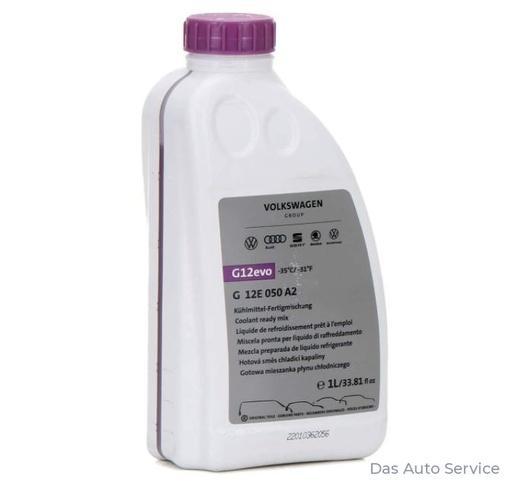
Genuine VAG G12Evo antifreeze G12E050A2 1.0l
Genuine G12evo coolant for topping up when you need to restore the coolant level. But remember, topping up doesn't fix whatever is causing the coolant loss.
View in shopRead more
- Diagnostics
- Engine overhauls
- 2.0 TDI EGR Problems (EA189): Cooler and Limp Mode
- DPF Problems in City Driving: How to Prevent Blockages
- 2.0 TDI Injector Problems: When to Replace All Four
Frequently asked questions
Why does my diesel engine produce white smoke when it's warm?
It could be coolant getting into the engine, an injector that isn't spraying fuel properly, or DPF regeneration. We need to find out what's causing the smoke rather than just guessing.
Does white smoke from the exhaust mean the head gasket has blown?
Not necessarily. The EGR cooler can also leak coolant, which is why we check the cooling system before jumping to conclusions.
Is white smoke normal during DPF regeneration?
You might briefly notice whiter smoke during regeneration. But if the smoke continues afterwards, we need to look for another cause.
Can I keep driving if my diesel is producing white smoke and losing coolant?
If the coolant level is dropping quickly or the engine temperature is rising, stop immediately. Coolant getting into the cylinders can damage the engine.