You put your foot down, look in the mirror and see a cloud of black smoke behind your car. I hear the same thing all the time at the workshop: "It's a diesel. Of course it smokes." No, it shouldn't! On a modern diesel engine with a DPF, black smoke from diesel when accelerating is not something you should accept as normal. Somewhere, the fuel isn't burning properly, and the cause might be completely different from what you think. The MAF sensor, EGR, injectors and turbo can all play a part. I'll explain what's happening, where the black smoke comes from and why you shouldn't start replacing parts without knowing what's wrong.
What does black smoke when accelerating mean?
For a diesel engine to run properly, it needs the right amount of fuel and enough air to burn it. When there's too much fuel or too little air, the fuel doesn't burn completely. That produces soot. And that's the black smoke you see behind the car. Put simply, the engine is getting more fuel than it can burn with the air available.
But there's an important detail here. On a modern diesel with a working DPF, that soot should be trapped by the filter, not coming out of the exhaust as a black cloud. So when you see black smoke, you need to find out not only why the engine is producing so much soot, but also why that soot is getting out. The two things are connected, but they're not the same problem. And that's where proper diagnostics begin.
What causes black smoke from diesel when accelerating?
There are quite a few possible causes, but they all come down to fuel, air and how the engine controls them. That's why I don't like hearing "it's probably the injectors" before anyone has even checked how the engine is running. The same cloud of smoke can have several different causes. Here's what we check most often.
- Not enough air. A split intercooler hose, a turbo problem or a blocked air filter can leave the engine short of air. There's fuel going in, but not enough air to burn it properly. The result is black smoke, and sometimes the car doesn't pull as well as it should. I've explained more about turbo problems in my article about the 2.0 TDI turbo.
- The MAF sensor. This is the sensor that measures how much air is entering the engine. If it starts sending incorrect readings, the engine computer makes decisions based on the wrong information. Imagine someone telling you there's plenty of air available when there actually isn't. The fuel no longer burns as it should.
- The EGR valve. Its job is to send some of the exhaust gases back into the engine. If it gets stuck open, too much exhaust gas can enter, leaving less fresh air for combustion. That's when problems start. I've written more about this in 2.0 TDI: EGR, Cooler and Limp Mode.
- The injectors. They need to deliver exactly the right amount of fuel in the right way. If an injector starts dripping or delivering too much fuel, the fuel no longer burns properly. And once again, you get soot. Have a look at my article about common rail injectors, where I explain why you shouldn't underestimate problems with them.
- A cracked or removed DPF. This is a slightly different situation. The filter is supposed to trap the soot produced by the engine. If it's cracked or has been removed, that soot can escape through the exhaust, where you can see it. So visible black smoke doesn't automatically mean the problem is only with combustion.
- Too much fuel after a remap. When an engine has been tuned to receive more fuel than it can burn properly, the result is black smoke again. More fuel doesn't necessarily mean better performance. Without enough air to burn it, you end up with soot instead of proper combustion.
What do we check at the workshop when a diesel smokes black?
The first thing I want to know is why the engine isn't burning its fuel properly. I don't start replacing the MAF sensor, EGR valve or injectors just because someone thinks that's where the problem is. That's the easiest way to replace several perfectly good parts and still end up with a car that smokes. At Das Auto Service, we check things in a logical order to find the actual cause, rather than just hide the symptom.
- We check for boost leaks. We make sure the air supplied by the turbo is actually reaching the engine. A split hose can throw everything off.
- We check the MAF sensor and turbo boost pressure while driving. It's not enough to leave the car standing still and look at a few readings. What matters is what happens when the engine is under load and you put your foot down.
- We check the EGR valve. We need to find out whether it's working properly or staying open when it shouldn't. If it isn't controlling the flow of exhaust gases correctly, combustion changes.
- We check the injector correction values. These help us see how the engine computer is adjusting fuel delivery. They're part of the diagnosis, not a reason to immediately blame the injectors.
Only after we've gathered this information can we work out where the problem is coming from. Sometimes it's the air supply, sometimes the fuel system or the engine management. That's why I insist on diagnosing the problem before carrying out repairs. You shouldn't have to pay for someone else's guesses.
Can black smoke clog the DPF?
Yes, and that's one reason not to put off the repair. When the engine produces too much soot, the DPF has to trap it. The more soot the engine produces, the faster the filter fills up. If you don't fix the underlying cause, the problem won't go away on its own. Quite the opposite. You could end up with a blocked DPF as well.
IMPORTANT! Black smoke means something isn't right with combustion or with the way soot is being trapped. If the engine is producing too much soot, the DPF fills up faster. Don't wait until the filter is blocked before finding out what's causing it.
Tip from Kris Mladenov: If an older diesel without a DPF gives off a small puff of black smoke for a moment when you accelerate hard, that can be normal for that engine. But on a modern TDI with a DPF, don't treat a visible cloud of black smoke as normal. Find out why it's happening before immediately blaming the injectors or turbo.
I hope you've found this article useful! If you have, I'd appreciate you sharing it with a friend who drives a diesel and thinks black smoke is perfectly normal. My mission has always been simple: when I know something, I want more people to know it too. Because the more you understand how your car works, the harder it is for someone to convince you to replace parts that are perfectly fine.
The solution in our shop
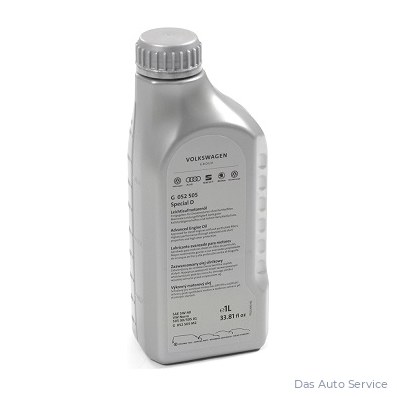
Genuine SpecialD 5W40 Volkswagen diesel oil 1L
SpecialD 5W40 engine oil is designed for TDI engines with unit injectors. Using the right oil is an important part of maintaining these engines properly.
View in shop
Genuine Longlife III FE 0W30 oil 5L
LongLife III engine oil is designed for common rail TDI engines. Choosing the correct oil is important for servicing, but it won't fix the underlying cause of black smoke.
View in shopRead more
- Diagnostics
- 2.0 TDI EGR Problems (EA189): Cooler and Limp Mode
- 2.0 TDI Common Rail Injectors: When to Replace Them
- 2.0 TDI Turbo Problems: Whistling, Smoke and Power Loss
Frequently asked questions
Why does my diesel produce black smoke when accelerating?
Because the fuel isn't burning completely. The cause could be too little air, too much fuel or a problem with the engine management system.
Can a faulty MAF sensor cause black smoke?
Yes, it can, but it's not necessarily the cause. The MAF sensor can send incorrect airflow readings, which is why we check it alongside turbo boost pressure, the EGR valve and the injectors.
Can black smoke damage the DPF?
Yes. If the engine produces too much soot, the DPF fills up faster and can become blocked if the underlying cause isn't fixed.