"My car keeps losing coolant. I top it up, and a few days later the warning light comes back on." I hear this all the time at the workshop. You open the bonnet, top up the coolant, the light goes out and you think everything's fine. But a little while later, it's back. So you top it up again. Here's the thing: coolant isn't fuel. Your car shouldn't be using it up. If the level keeps dropping, something's wrong somewhere, and that coolant warning light is trying to tell you. Sometimes it's just a sensor. Sometimes it's a leak. And sometimes it's something much more serious. I'll explain how to tell the difference and when you need to stop straight away.
What does the coolant warning light mean?
The first thing I want you to look at is the colour of the warning light. Not every warning light means your engine is overheating, but that doesn't mean you can always carry on driving either. There's a big difference between a low coolant level warning and a warning that your engine is already in danger. That's why the colour matters so much.
- Yellow warning light – usually means the coolant level is low or there's a problem with the sensor that monitors it. It doesn't necessarily mean the engine is overheating, but you do need to find out why the light is on.
- Red warning light – could mean the engine is overheating or the coolant level is dangerously low. This is no time to take chances. Pull over somewhere safe and switch off the engine.
There's something a lot of people miss. The warning light tells you there's a problem, but it doesn't necessarily tell you which part is causing it. That's why I don't like repairs that go, "The light's on, so let's replace the sensor." First, we need to find out what's actually happening.
Can I drive with the coolant warning light on?
If the light is red, my answer is simple: no. Pull over somewhere safe and switch off the engine. Don't think, "I'll just drive a little further until I get home," because that little bit further could cost you a very expensive repair. If your engine is overheating, have a read of what not to do when your engine overheatstoo. I want you to know what to do before you ever find yourself in that situation.
If the light is yellow, start by checking the coolant level, but only when the engine is cold. Don't unscrew the cap as soon as you've stopped. If the level has dropped, we need to find out why. Topping it up might switch off the warning light, but it won't fix whatever caused the problem. And if the warning keeps coming back, your car is making it pretty clear that something needs attention.
What causes coolant loss and a coolant warning light?
Now this is where things get interesting. Plenty of owners come to us saying, "There's nothing dripping anywhere, but the coolant keeps disappearing." Just because you can't see a puddle under the car doesn't mean there isn't a leak. There are several possible causes, and that's exactly why I don't want you replacing parts blindly. Here's what we check most often.
- Water pump or thermostat – two places where coolant can leak. If you drive a 1.4 TSI EA211, have a look at my separate article about the water pump and thermostat. I've also covered the same problem on the 1.8 and 2.0 TSI EA888 Gen3.
- Hose, radiator or heater matrix – coolant can escape from different parts of the cooling system. Sometimes the leak is easy to spot. Other times, we need to pressure-test the system to find it.
- Coolant level sensor in the expansion tank – the coolant might be at exactly the right level, but the warning light comes on because of the sensor or its electrical connection. That's why we check first and replace parts afterwards.
- Coolant burning inside the engine – this is the most serious possibility. We're no longer talking about a simple external leak. We're talking about coolant getting somewhere it shouldn't and burning inside the engine. That's not something you want to ignore.
I want you to remember one thing. It's perfectly normal not to know where your coolant is disappearing to. That's what diagnostics are for. What isn't normal is someone replacing one part after another until they happen to find the problem. That's not repairing your car. That's guessing with your money.
What do we check at the workshop when the light comes on?
At Das Auto Service, we don't start by ordering parts. We start by checking the car, because the same warning light can come on for several different reasons. I want to establish whether the coolant is actually disappearing, whether the system is losing pressure or whether the warning is coming from the sensor. Here's how we track down the cause.
- We check the coolant level with the engine cold. That's the first step, because we need to know whether the coolant level has actually dropped.
- We pressure-test the cooling system. This helps us find leaks that might not be visible during a normal inspection.
- We check the coolant level sensor and its wiring. If the coolant is at the correct level, we need to find out why the car keeps warning you.
- We check for gases in the coolant. This helps us identify signs of a more serious problem inside the engine.
Once we've done these checks, we can talk about an actual cause rather than making guesses. To me, that's how a car should be repaired. I don't want to tell you, "It might be this, let's replace it and see." I want to explain what we've found and why the repair is necessary.
WARNING! Never open the coolant expansion tank cap when the engine is hot. The cooling system is under pressure, and hot coolant can cause serious burns. Wait until the engine has cooled down before checking or topping up the coolant.
Which coolant should I top up with, and can I use water?
Here's another mistake I see all the time. Someone notices the coolant level has dropped and pours in whatever they've got handy. But you need to use the correct coolant for your car. You can't just mix different types together and hope for the best. I've explained this in detail in my article about whether you can mix G12, G12+, G13 and G12evo.
Water can help you out in an emergency, but it's not a long-term solution. Coolant has an important job to do in the cooling system, and I don't want you replacing it with water just because it's easier. At our workshop, I recommend changing the coolant every third heating season. That way, looking after the cooling system means more than just topping it up whenever the warning light comes on.
Tip from Kris Mladenov: If the coolant level has dropped, top it up only with the correct coolant, and don't assume the problem is fixed. If the warning light comes back on, find out what's causing it instead of just adding more coolant. Keep water for emergencies, not as a permanent solution.
I hope you've found this article useful! If you have, I'd really appreciate you sharing it with a friend who keeps topping up their coolant or can't work out why that warning light keeps coming back. My mission is simple: when I know something, I want more people to know it too. Because getting something checked in time could save you a very expensive repair. And remember, the money for that repair will come out of your pocket, not mine. So I'm telling you this as a friend: don't ignore your coolant warning light.
The solution in our shop
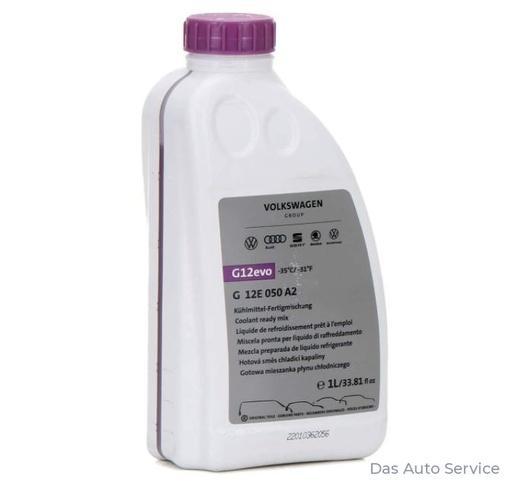
Genuine VAG G12Evo antifreeze G12E050A2 1.0l
Genuine G12evo coolant – suitable for topping up when your car requires this specification. It's important to use the correct coolant for your cooling system.
View in shopRead more
- Diagnostics
- Routine servicing
- G12 G13 G12evo Coolant Compatibility Guide
- 1.4 TSI EA211 Water Pump and Thermostat Problems
- EA888 Gen3 Water Pump Leak: Causes and Fix
- Engine Overheating: What to Do and What to Avoid
Frequently asked questions
Why is my car losing coolant without a visible leak?
There could be a leak from the water pump, thermostat, a hose, the radiator or the heater matrix that's difficult to spot. A more serious possibility is coolant getting inside the engine and burning there. You need a proper check, not guesswork.
Can I top up with water instead of coolant?
Water is only for emergencies, not everyday driving. Use the correct coolant for your car, and don't mix different types unless you've checked that they're compatible.
Why is my coolant warning light flashing?
The coolant level might be low, or the sensor could be giving a false warning. Check the level when the engine is cold. If the light keeps flashing, the car needs diagnosing.
Is it dangerous to drive with a red coolant warning light?
Yes. A red warning light could mean the engine is overheating or the coolant level is dangerously low. Pull over safely and switch off the engine, because carrying on could lead to serious engine damage and an expensive repair.