Do you know which fluid in your car gets forgotten about the most? The brake fluid. You keep an eye on your engine oil, you check the coolant now and then, but when did you last change your brake fluid? It's the stuff you rely on every single time you press the brake pedal. And I'm not just talking about whether your car will stop. I'm talking about whether it'll stop when you really need it to. I hear this all the time at the workshop: "Kris, my brakes work fine. Why would I need to change the fluid?" Well, let me explain DOT 4 vs DOT 5.1 brake fluid, why you can't just pour in any old bottle, and why I insist on changing brake fluid every 2 years.
What's the difference between DOT 4 and DOT 5.1 brake fluid?
Both DOT 4 and DOT 5.1 are glycol-based brake fluids. The difference is in how they behave, especially their boiling points and how thick they are. Put simply, one fluid can behave differently from the other when your brakes get hot or when it's freezing outside. And that matters. Because your braking system isn't just a pedal, a few pipes and some pads squeezing against the discs.
On modern Audi, VW, Škoda, SEAT, Cupra, Porsche, Bentley and Lamborghini cars, the brakes work together with ABS, ESP and the electronic parking brake. ABS stops your wheels from locking up under hard braking, while ESP helps keep your car going in the right direction when it starts losing grip. All these systems depend on the brake fluid doing its job properly. That's why the manufacturer specifies exactly which standard the fluid must meet. I don't choose brake fluid just because the bottle has DOT 4 or DOT 5.1 written on it in big letters.
Why can't I just use any DOT 4 brake fluid?
Imagine you've bought a bottle of brake fluid that says DOT 4 on the label. You're thinking, "Well, DOT 4 is DOT 4. How different can it be?" I get it. At first glance, that sounds perfectly reasonable. But here's the thing! ABS and ESP are designed to work with fluid that has a particular thickness, even at low temperatures. Use a different fluid and you could change how those systems behave. And when you really need them, the last thing you want is to wonder whether they're working properly.
That's why, at Das Auto Service, we first check what the manufacturer requires for your particular car. We don't just go by what's printed on the bottle. And we certainly don't assume that because a fluid is right for one VW, it must also be right for every Audi or Porsche. The exact specification matters. That's the difference between simply pouring in some fluid and servicing your brakes properly. And when your safety is involved, you can probably guess which one I'd choose.
Which brake fluid should I never use?
There's one really important thing I want you to remember here: DOT 5 is not the same as DOT 5.1. I know the numbers make it look as though DOT 5.1 is just another version of DOT 5, but chemically they're very different. DOT 5 is silicone-based, while DOT 4 and DOT 5.1 are glycol-based. Silicone DOT 5 doesn't mix with them, and it isn't intended for the cars we're talking about here. Don't let the bigger number fool you.
If someone tells you DOT 5 is better simply because the number is higher, don't take that as a proper technical explanation. With brake fluid, a higher number doesn't automatically mean a better choice for your car. What matters is what your braking system actually needs. I wouldn't experiment with something this important. And I really don't want you doing it either.
Why should I change my brake fluid every 2 years?
Because brake fluid absorbs moisture over time. And that moisture lowers its boiling point. Imagine you're braking hard or coming down a long hill, and your brakes get seriously hot. If the fluid has absorbed enough moisture, it can start to boil and produce vapour inside the system. Then you press the brake pedal and it feels soft, or worse, sinks towards the floor. And that's the moment you realise why changing the fluid wasn't such an unnecessary job after all.
That's exactly why we change brake fluid every 2 years at Das Auto Service. We don't wait for the pedal to go soft. We don't wait for a warning light on the dashboard. And we certainly don't judge the fluid by how it looks in the reservoir. If you'd like to understand what's actually happening inside the fluid, have a read of my other article, why VAG brake fluid needs changing and when. I've explained why time matters so much. Trust me, your brakes are not something you want to put off servicing.
How do you change brake fluid properly?
Changing brake fluid isn't just a matter of sucking a bit out of the reservoir and topping it up with fresh fluid. The old fluid needs to be properly replaced throughout the braking system, without leaving any air trapped inside. We use a special machine that pushes fresh fluid through under pressure and allows us to bleed the system, removing any air. We follow the exact procedure specified by the manufacturer for your car. Here's how we do it.
- We replace the fluid using a pressure brake bleeding machine, making sure the fresh fluid flows through the system correctly.
- We follow the manufacturer's exact bleeding sequence and, when the procedure calls for it, we also bleed the ABS module – the unit that controls brake pressure.
- Finally, we check the fluid level and the brake pedal to make sure everything has been serviced properly.
There are a few extra things to consider with the sporty RS models, and those procedures need to be followed too. That's why I've written a separate article about bleeding the brakes on Audi RS models. Here's what I really want you to understand: having the right brake fluid isn't enough on its own. You also need to change it properly. One is just as important as the other.
WARNING! You can't reliably tell how old or worn out brake fluid is just by looking at it. Even if it looks perfectly clean in the reservoir, that doesn't mean it still performs as it should. Change it every 2 years, regardless of how it looks.
Tip from Kris Mladenov: Make a note of the date your brake fluid was last changed. Two years go by surprisingly quickly, especially when your brakes feel perfectly normal and there's nothing to remind you that a service is due. Don't wait until something goes wrong before you think about it.
I hope you've found this article useful! If you have, I'd love you to share it with a friend who cares about their car as much as you do. My mission is simple: when I know something important, I want more people to know it too. Because I'd much rather explain why you need to change a fluid while everything is still working properly than have you wondering afterwards why your brakes didn't behave the way you expected. Look after yourself and your car!
The solution in our shop
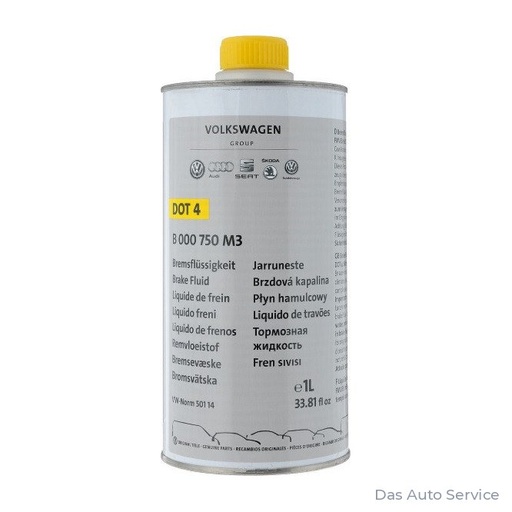
Genuine Audi/Volkswagen DOT 4 brake fluid B000750M3 1l
Genuine DOT 4 brake fluid, 1 litre. We use genuine brake fluid when it meets the exact specification required for the vehicle.
View in shop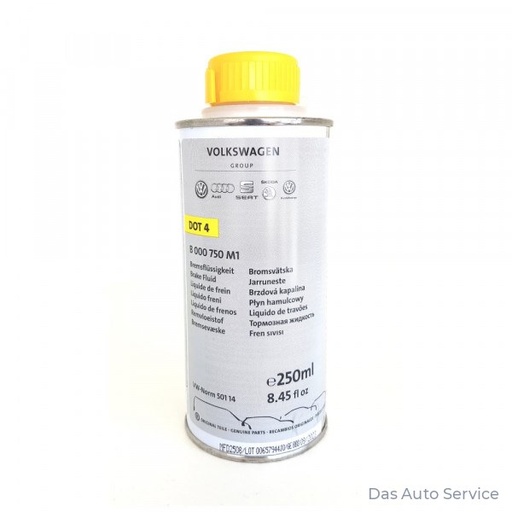
Genuine DOT 4 brake fluid B000750M1 Audi/Volkswagen 250ml
Genuine DOT 4 brake fluid, 250 ml. The same type of genuine brake fluid in a smaller bottle. We still check compatibility with your particular car.
View in shopRead more
Frequently asked questions
Should I use DOT 4 or DOT 5.1 in my VW?
It depends on the exact specification the manufacturer requires for your car. Don't choose a fluid just because the bottle says DOT 4 or DOT 5.1. Check which fluid your braking system is designed to use.
How often should I change my brake fluid?
Every 2 years. Brake fluid absorbs moisture, which lowers its boiling point. Don't wait until you notice something wrong with the brake pedal.
Can I mix different types of brake fluid?
DOT 4 and DOT 5.1 are both glycol-based, but that doesn't mean every fluid is suitable for your car. DOT 5 is silicone-based and must not be mixed with either of them. Always follow the manufacturer's requirements.