Supermarket 5W-30 engine oil, or a bottle of 5W-40 from a DIY shop – sounds like a bargain, doesn't it? The bottle has the same numbers as the oil we offer you at our workshop, so naturally you're wondering what the difference is. I get asked this all the time, and I completely understand. But there's one little detail that a lot of people miss. Just because an oil says 5W-30 doesn't mean it's right for your engine. That's only half the story. And the other half could end up causing you some very expensive headaches.
What do the numbers and letters on the bottle actually mean?
Let me explain something I think every car owner should know. When you look at a bottle of engine oil, you'll see all sorts of letters and numbers, but they don't all mean the same thing. Some tell you how thick the oil is, others tell you which general standards it meets, and some relate to the specific engine it's designed for. This is where people get confused. Because two oils with exactly the same viscosity can have completely different properties.
- 5W-30 – this is the oil's viscosity, which tells you how it behaves at different temperatures. It doesn't tell you whether the oil is right for your engine. The same goes for 5W-40.
- ACEA and API – these are general classifications used to describe the properties of engine oils. They're useful, but on their own they aren't enough to tell you which oil your particular car needs.
- VW 504 00, VW 507 00 and others – these are the specifications you need to look for, depending on what the manufacturer requires. What matters is that the oil has the correct official approval, not just a claim on the bottle that it's suitable.
Imagine you've got two bottles of 5W-30 sitting in front of you. They look almost identical from the front, but when you read the labels carefully, you discover that one has the approval your engine needs and the other doesn't. That's why I never choose engine oil just by looking at the big numbers on the front. If you'd like to understand these markings better, have a read of what the numbers on the oil bottle mean. I've explained them in a way that will help you recognise them yourself next time.
Why won't we use cheap supermarket oil?
I want you to understand something here. I'm not saying every oil sold in a supermarket is bad, or that a bottle somehow becomes better quality just because it's sold in a specialist shop. What matters is what's inside, which requirements it meets and whether we can trust it. When I service your car, I'm responsible for what goes into your engine. And that's why I won't take chances with something I can't verify.
- There's often no official approval. The label might say "suitable for VW 504 00" or "meets VW 507 00". That isn't necessarily the same as an official manufacturer approval. It's an important difference, and one you really shouldn't ignore.
- The oil might not have the required low sulphated ash content. This is particularly important if your engine has a DPF, because ash builds up inside the diesel particulate filter. And believe me, that's not something you want to ruin by using the wrong oil.
- We can't be certain where the oil came from or how it was stored. Even having the correct markings on the label doesn't answer those questions. For me, knowing exactly what I'm putting into your engine matters far more than simply trusting the promises printed on a bottle.
See where the problem is? It isn't that the oil is cheap. The problem starts when you choose something purely because the price looks attractive, without knowing whether it's actually suitable. Your engine can't read the label and tell you you've made a mistake. You might not find out until something goes wrong. And by then, you're the one paying the repair bill.
What are the most common mistakes when choosing engine oil?
Most of the time, it starts with good intentions. You want to look after your car, make sure it has enough oil and avoid spending money unnecessarily. But there are so many conflicting opinions online that it's easy to get confused. Especially when someone tells you that all oils with the same viscosity are basically identical. They're not. And I want to help you avoid the mistakes I see most often.
- Choosing oil based on viscosity alone. You see 5W-30 in your owner's manual, buy the first bottle of 5W-30 you find and assume that's that. But if the oil doesn't have the required approval, getting the viscosity right won't save you.
- Using the same oil in a petrol and a diesel engine without checking the requirements. Some oils are approved for both, but you need to confirm that by checking the approvals. Don't just assume.
- Leaving the oil change longer because the oil is synthetic. I've heard this one countless times: "But it's really good oil, so why would I need to change it so often?" Because even high-quality oil doesn't last forever.
And here's something I want to tell you as a friend. You don't need to know as much about engine oil as a mechanic to take good care of your car. You just need to know what to check and not believe every opinion you read in an online group. That's exactly why I write these articles. I want you to make the right decision before you're reaching for your wallet to pay for repairs.
How often should you change supermarket 5W-30 engine oil?
My answer for cars driven in Bulgaria is simple: change the engine oil every 10,000 km or once a year, whichever comes first. It doesn't matter whether the oil is synthetic, whether it says LongLife on the bottle or how wonderful someone tells you it is. We change the oil filter, fuel filter, air filter and cabin filter together with the engine oil. Every single one. We don't leave any of them until the next service.
I know the manufacturer may allow longer service intervals, but those recommendations also take environmental requirements into account, not just how long the engine will last. I'd rather we look after your engine than find out how long it can survive without a service. If you'd like to understand why I insist on this interval, read when to change your engine oil. I've explained my recommendation in detail there.
WARNING! The difference in the cost of engine oil is tiny compared with repairing a turbo, timing chain or DPF. Don't risk your engine for the sake of a bottle of oil when you're not sure it meets the manufacturer's requirements.
Tip from Kris Mladenov: If you're buying your own engine oil, open your owner's manual and find the exact approval your engine needs. Then look for it on the bottle – every word and every number must match. Check that the oil actually has official approval, rather than just saying "suitable for". That's far more important than the big 5W-30 numbers on the front.
I hope this article has helped you! If it has, I'd love you to share it with a friend who chooses their own engine oil. My mission is simple: when I know something useful, I want more people to know it too. Because having the right information today can save you a lot of trouble tomorrow. And I'd much rather see you at Das Auto Service for a routine service than because your engine has failed.
The solution in our shop
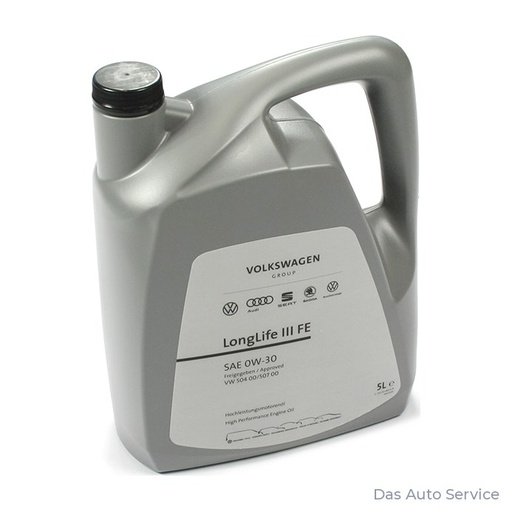
Genuine Longlife III FE 0W30 oil 5L
Genuine LongLife III engine oil with VW 504 00 and VW 507 00 approvals. A suitable choice for engines where the manufacturer requires these specifications.
View in shopRead more
- Routine servicing
- Genuine VAG parts and accessories
- VW 504 507 Engine Oil: What LongLife Really Means
- VAG Oil Change Interval: When to Service Your Car
Frequently asked questions
Is supermarket engine oil suitable for a VW?
Yes, provided it has the exact official approval your engine requires and you're confident about where it came from and how it was stored. The shop you buy it from doesn't determine its quality.
What does "meets VW 504 00" actually mean?
It means the oil manufacturer claims the product meets that specification. It doesn't necessarily mean the oil has official VW approval, and that distinction matters.
Does the brand of engine oil matter?
Having the correct official approval, good quality and a reliable source matters more. Don't choose engine oil based on brand, price or viscosity alone.
Can I drive more than 10,000 km with synthetic engine oil?
My recommendation for cars driven in Bulgaria is to change the engine oil and all filters every 10,000 km or once a year, whichever comes first. That applies to synthetic oils too, including LongLife.