"What is AdBlue, and why does my car keep asking me to top it up?" I hear this question regularly at the workshop, especially from owners of newer diesel cars. You're driving along quite happily when suddenly an AdBlue warning appears on the dashboard. The car starts counting down the remaining kilometres and eventually warns you that the engine won't start. Naturally, that makes people nervous. The truth is, there's nothing to worry about with AdBlue, as long as you know what it does, where to put it and what not to do with it. I'll explain everything in plain English, without unnecessary technical jargon.
What is AdBlue and why does a diesel engine need it?
AdBlue is a solution of urea in water. That sounds complicated, but it's simply a special fluid that helps diesel cars produce fewer harmful emissions. It doesn't mix with the fuel and isn't involved in running the engine. Instead, it's injected into the exhaust system, where the exhaust gases pass through a special catalytic converter called an SCR catalyst. This is where harmful nitrogen oxides are converted into nitrogen and water.
Why do we need this system in the first place? Because modern diesel engines have to meet strict emissions standards, and they can't meet them without AdBlue. And here's the interesting part. Your car doesn't just remind you to top up the fluid. It can reach a point where it won't let you start the engine at all. Not because the engine has broken down, but because the system is designed to prevent normal operation without enough AdBlue.
How much AdBlue does my car use?
That's the next question I hear all the time. How many litres do I need to add, and how many kilometres will they last? The answer depends on your engine and how you drive. There's no single figure that applies to every diesel car, which is why I don't like making blanket promises. Two cars can use different amounts of AdBlue without either of them necessarily having a problem.
What's more important is paying attention to what your dashboard tells you. Cars with this system show you how many kilometres you have left before the next engine start may be restricted. Don't get too caught up in the number of litres. Pay attention to those warnings instead. If your car tells you to top up, do it in good time. There's absolutely no point waiting until the last minute and then wondering why you can't drive away.
Where do I refill AdBlue and how do I find the tank?
On most cars, you open the fuel filler flap and you'll see a separate AdBlue filler cap next to the diesel cap. But that's not the case on every model. Some cars have the AdBlue filler in the boot, while others have it under the bonnet. So if you can't find it straight away, don't start pulling off plastic covers and searching at random. Open your owner's manual and check exactly where it is.
The most important thing is not to mix up the two tanks. AdBlue is not a diesel additive and has absolutely no business going into your fuel tank. These are two completely separate systems doing different jobs. The same applies the other way round: only the correct fluid should ever go into the AdBlue tank. Not water, not some homemade mixture and certainly not whatever you've got left over in the garage.
Can AdBlue freeze in winter?
Yes! AdBlue freezes at around −11°C. And now you're probably wondering what happens if you leave your car outside on a freezing winter night. Nothing unusual. The system is designed to work in those conditions too. Your car has heaters that help thaw the frozen fluid. There's no need to invent your own solution to a problem the manufacturer has already thought about.
But there's something important I want to point out here. Never add anything to the tank in an attempt to stop AdBlue from freezing. No antifreeze, no other chemicals and no mixtures someone has recommended to you. The system is designed to work with a specific fluid, not whatever you feel like experimenting with. Sometimes, trying to prevent a problem that doesn't really exist can create a very real one.
What are the most common AdBlue system problems?
The fluid itself is straightforward, but the system that uses it has several components that can cause trouble. When a warning light comes on, it doesn't automatically mean you just need to top up. Sometimes one of these components is at fault. That's why, when something goes wrong, we need to find out exactly what's not working before we start replacing parts.
- The tank heater and pump – the heater helps the fluid cope with low temperatures, while the pump delivers it to the system. If either of these components isn't working properly, simply topping up won't solve the problem.
- NOx sensors – these monitor nitrogen oxides in the exhaust gases. Their readings are important for the system to work correctly, so a faulty sensor can trigger dashboard warnings.
- The AdBlue dosing injector – this injects AdBlue into the exhaust system. Crystals can form around the injector and prevent the fluid from being delivered properly.
If you'd like to understand more about what happens when the system starts counting down the kilometres until the engine can no longer be started, read AdBlue on the 2.0 TDI EA288: Engine Won't Start After 1,000 km. I've covered that subject separately because an engine start restriction warning deserves more attention than a simple top-up reminder.
WARNING! Never put AdBlue into the diesel fuel tank, and never add water to the AdBlue tank. If you put the wrong fluid in either tank, don't try to fix the mistake by adding more fluid. Mixing them up can lead to an expensive repair.
Which AdBlue should I buy?
There's no need to look for miracle products here. What matters is that the fluid meets the ISO 22241 standard and has been stored properly. AdBlue needs to be clean because the system it passes through doesn't tolerate contamination. That's why I prefer sealed containers, so you know exactly what you're putting into the car. Don't leave it sitting in direct sunlight either.
Tip from Kris Mladenov: I recommend buying AdBlue that meets ISO 22241, choosing a sealed container and keeping it out of direct sunlight. Don't add anything to it, and only pour it into the designated AdBlue tank. With this system, cleanliness is everything. And if the warning doesn't disappear after topping up, find out what's causing it rather than continuing to pour more fluid in.
I hope you've found this article useful! If you have, I'd be happy if you shared it with a friend who drives a diesel car. My mission is simple: when I know something, I want more people to know it too. Because the better you understand your car, the harder it is for someone to confuse you with unnecessary repairs and horror stories.
The solution in our shop
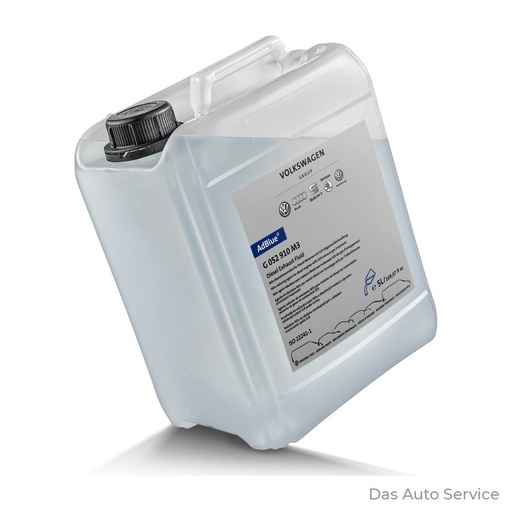
Genuine VAG AdBlue® fluid G052910M4 10l
Genuine AdBlue 10 l – a good choice for topping up when your car asks for more fluid. The important thing is that the container is sealed and the fluid is clean.
View in shopRead more
Frequently asked questions
What is AdBlue?
AdBlue is a solution of urea in water that is injected into a diesel car's exhaust system. It helps convert harmful nitrogen oxides into nitrogen and water.
At what temperature does AdBlue freeze?
At around −11°C. Your car has heaters that help the system work in low temperatures, so you shouldn't add anything to prevent freezing.
What happens if my car runs out of AdBlue?
Your car starts warning you about the remaining kilometres. If the fluid runs out and the countdown reaches its limit, the engine may refuse to start again.