"Kris, is AdBlue from a pump the same as the stuff in a bottle? Am I going to damage my car if I fill up at a petrol station?" I get asked this quite often, and I understand why people worry. Some say AdBlue from a pump is only for lorries, while others reckon the bottled stuff is better quality. The truth is, the fluid should be exactly the same. But there are a few small things that can cause you some very big headaches. And that's what I want to talk you through, because something as simple as a dirty funnel can land you with a problem you really don't need.
What exactly is AdBlue and what does it do?
AdBlue is a fluid used in diesel cars fitted with an SCR system. It's a solution of urea in demineralised water, made to the ISO 22241 standard. Sounds complicated, but the idea is actually quite simple. Your car injects AdBlue into the exhaust system to reduce the harmful nitrogen oxides coming out with the exhaust gases. In other words, AdBlue isn't a diesel additive, and it has absolutely no business going into your fuel tank.
SCR is the system that handles this part of cleaning up the exhaust gases. It uses AdBlue to help your diesel engine produce fewer harmful emissions. That's why your car has a separate tank for the fluid and warns you when the level starts getting low. It's not something you can simply ignore. And that's where the questions start. Where should you top up, and is every type of AdBlue suitable?
AdBlue pump vs bottle: which is better?
I'll give you a straight answer. If both fluids meet ISO 22241 and neither is contaminated, there's no reason why AdBlue from a pump should be any worse than the bottled stuff. The standard is exactly the same. What matters isn't so much where you buy it, but how it's been stored and how you pour it into the car. Because even good-quality AdBlue can become contaminated before it reaches the tank.
- AdBlue that meets ISO 22241 is the same fluid, whether it comes from a pump or a bottle. What matters is that it meets the standard and is clean.
- Cleanliness is incredibly important. If you use a dirty funnel or the pump nozzle is contaminated, you can introduce dirt into the system. And trust me, that system doesn't appreciate surprises like that.
- AdBlue pumps designed for lorries often have larger nozzles that won't fit into a car's filler neck. Don't try to force one in. If it doesn't fit, use a suitable nozzle or a bottle instead.
Picture this. You buy some good-quality AdBlue, open the bottle and grab the first funnel you can find in the garage. The same one that's been sitting on a shelf collecting dust. Well, what's the point of choosing quality AdBlue if you're going to contaminate it yourself? That's why I prefer using a clean filling nozzle that fits the filler neck properly. Simple and safe.
What are the most common mistakes when topping up AdBlue?
The biggest problem usually isn't choosing between a pump and a bottle. It's that people don't take the actual topping-up process seriously enough. AdBlue looks like an ordinary liquid, so it's easy to think there's not much you can get wrong. But there are a few mistakes I really want you to avoid.
- Using an old funnel from the garage. It might look clean, but it could have dust, dirt or traces of other fluids on it. Don't take the risk.
- Buying a bottle and leaving it in the sun or freezing cold for months. How you store AdBlue matters, and it's not something you should overlook.
- Putting off topping up even though your car is already warning you. If your dashboard says engine start not possible in 1000 km, don't treat it as an empty threat. You could reach the point where your car refuses to start.
That last mistake particularly bothers me because it's completely avoidable. Your car gives you plenty of warning, but you tell yourself, "I've still got a few miles left. I'll top it up next week." Then another week goes by, and suddenly you've run out of time to put it off. Why put yourself through that? As soon as you see the first warning, sort out the AdBlue.
How should I store AdBlue properly?
If you prefer buying AdBlue in a bottle, there's absolutely nothing wrong with that. Just don't leave it lying around wherever you happen to put it down. The fluid needs to be stored properly, and if you don't follow those requirements, its quality can suffer. Here's what you need to know.
- Keep the bottle in the shade, away from direct sunlight and excessive heat. Don't leave it baking in the sun for months.
- Keep the container tightly closed. That reduces the risk of dust and other contaminants getting inside.
- AdBlue freezes at around −11°C. That doesn't mean you need to throw it away. Once it thaws, the fluid can still be used.
I particularly want to explain the freezing part because there's a lot of confusion about it. If your bottle of AdBlue freezes during winter, that alone doesn't mean it's no longer usable. You can still use it once it has thawed. The important thing is to keep it free from contamination and store it properly. Not every change in how the fluid looks means you need to buy a new bottle.
WARNING! Never pour AdBlue into the fuel tank! It's a separate fluid and it doesn't belong anywhere near your diesel. If you accidentally put AdBlue into the fuel tank, do not start the engine. Don't try to fix the mistake by adding more diesel. Contact a workshop before doing anything else.
Tip from Kris Mladenov: I recommend topping up your AdBlue as soon as the first dashboard warning appears. Don't wait until you've only got a few kilometres left, and don't turn something so simple into an unnecessary headache. Choose AdBlue that meets ISO 22241 and always use a clean filling nozzle. Your car doesn't need experiments, and you certainly don't need unexpected repair bills.
I hope you've found this article useful! If you have, I'd really appreciate you sharing it with a friend who drives a diesel with AdBlue. My mission is simple: when I know something useful, I want more people to know it too. Because sometimes a bit of advice at the right time can save you a lot of stress and money. And remember, when an unnecessary repair comes along, the money comes out of your pocket, not mine.
The solution in our shop
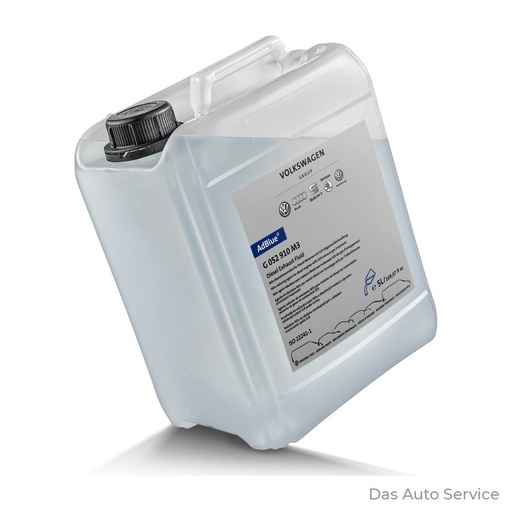
Genuine VAG AdBlue® fluid G052910M4 10l
Genuine AdBlue, 10 litres, with a suitable filling nozzle that fits the AdBlue filler neck. This lets you top up cleanly and easily, without having to hunt around the garage for an old funnel.
View in shopRead more
Frequently asked questions
Is there a difference between AdBlue from a pump and a bottle?
If both fluids meet ISO 22241 and are clean, there's no significant difference. What matters more is how they've been stored and whether the filling nozzle is clean.
What happens if I put the wrong fluid in?
If you put AdBlue into the fuel tank, don't start the engine. Contact a workshop. If you've poured another fluid into the AdBlue tank, don't try experimenting with ways to fix it either. Get professional help.
Does AdBlue freeze in winter?
Yes, AdBlue freezes at around −11°C. Once it thaws, it can still be used, provided it hasn't been contaminated.
Can I wait until the last few kilometres before topping up AdBlue?
I wouldn't recommend it. If you use up the remaining distance shown on the dashboard, your car may refuse to start. Top up as soon as the first warning appears.