November comes around, and almost every day someone walks into our workshop holding a bottle of coolant and asks me, "Kris, is this the right one for my car?" The coolant in the bottle is pink, the stuff in the expansion tank is purple, and he remembers the coolant in his previous car being blue. No wonder he's confused. I completely understand. Over the past twenty years, Volkswagen Group has introduced several generations of coolant, and choosing the right one has become a bit of a minefield. So let me explain G12 G13 G12evo coolant compatibility, what each type actually is and how to avoid an expensive repair over something as simple as topping up your coolant.
What's the difference between G11, G12, G13 and G12evo?
VAG coolants have a G designation followed by a number. Each new generation followed the previous one and has its own factory specification. I'll take you through them in order, so you can see where all the confusion comes from:
- G11 is the oldest. It's a blue-green, silicate-based coolant used in cars from the 1990s.
- G12 arrived around 1996. It's red and contains no silicates. But be very careful here! G12 must not be mixed with G11 because the mixture can form sludge that blocks the radiator and heater matrix.
- G12+ and G12++ came next. G12++ brought back a small amount of silicate to give aluminium better protection.
- G13 appeared around 2012. It's purple, and some of the glycol was replaced with glycerine.
- G12evo is the latest generation. It's used in more recent cars and, according to the manufacturer, is compatible with G12++ and G13.
Here's something really important I want you to remember: never choose coolant by its colour! The colour doesn't tell you the specification. There are all sorts of aftermarket coolants on the market, dyed in every colour you can imagine. Check what's written on the bottle and which coolant your car actually needs. Don't just look at whether it's pink, red or purple.
G12 G13 G12evo coolant compatibility: can you mix them?
As a general rule, you can top up an older coolant with a newer generation from the same family, but not the other way round. There's one rule I really want you to remember, though: never mix G11 with original G12. At Das Auto Service, we don't like playing guessing games with coolant. If we don't know what's already in the system, we'd rather replace all of it. That way, we know exactly what we've put in, and we won't create a problem your car didn't have in the first place.
If the level has dropped and you only need a tiny top-up to get to the workshop, use distilled water. It won't harm the cooling system, but it will dilute the coolant and reduce its freeze protection. Afterwards, make sure you check the concentration and correct it. Don't leave your car like that all winter, because you'll be the one paying for the repairs if something goes wrong.
How much coolant and water should I use?
If you've bought coolant concentrate, you need to dilute it with distilled water. Not tap water! Tap water contains minerals that cause limescale, and the last place you want that building up is inside your car's water pump and radiator. Here are the concentrations specified by the manufacturer:
- 40% coolant concentrate gives you freeze protection down to around -25 °C.
- 50% coolant concentrate gives you freeze protection down to around -36 °C.
For our conditions in Bulgaria, 40% is perfectly adequate in most years. And don't think you're doing your engine a favour by adding extra concentrate. Above 60%, the coolant becomes less effective at carrying heat away, and freeze protection doesn't improve. See? More isn't always better.
How can I tell if my coolant is still good?
The easiest way is with a refractometer. It's a small tool that lets us check the temperature your coolant protects against in about a minute. At Das Auto Service, we do this at every autumn service. But we don't just check the freezing point. We also look at the condition of the coolant and check the expansion tank for oil, rust or sludge. If we find oil in the coolant, that's a completely different problem. At that point, you don't need a simple top-up. You need a proper diagnosis.
So how often should you replace it? Every third heating season. Not when it turns dark, and not because someone in a Facebook group tells you it's time. As coolant ages, it gradually loses the additives that protect your engine, and tiny pits can start forming in the aluminium engine block. It might look perfectly clean from the outside while it's already eating away at the metal inside. That's why I want you to check the protection every autumn. If it's weakened, or someone's topped it up with an unknown coolant, don't wait until the third season.
What coolant should you use in a Porsche?
Porsche has its own coolant, and I recommend sticking with it. On a Cayenne or Panamera, a faulty water pump, thermostat or radiator can already give you more than enough headaches. Why risk creating another problem over something as simple as coolant? Use exactly what's specified for your car.
Advice from Kris Mladenov: My friend, don't buy coolant just because it's the same colour as what's in your expansion tank. And don't grab the first bottle you see at a petrol station. Check the exact specification for your car and keep a bottle of the correct coolant in your boot. If you're not sure which one you need, pop into the workshop. We'll tell you in five minutes.
Next time you're standing in front of a shelf full of coolant, I don't want you wondering which colour to choose. You now know the difference between the generations and why you shouldn't just mix whatever you happen to find. I'm telling you this because I want you to look after your car and your money. If you've found this useful, send the article to a friend who drives a VAG car. You might save them quite a few headaches.
The right coolant from our shop
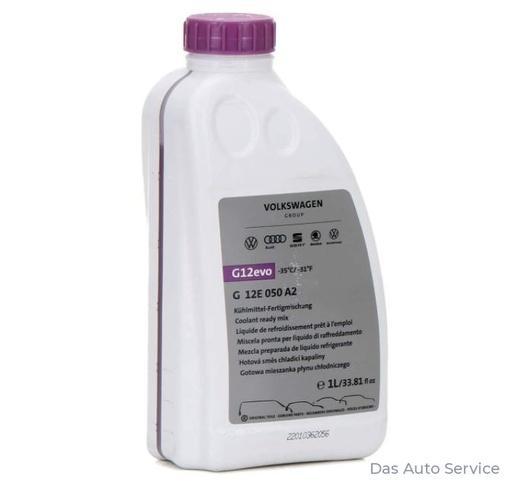
Genuine VAG G12Evo coolant G12E050A2 1.0 l
Genuine G12evo coolant concentrate for the cooling systems of newer VAG cars. Compatible with G12++ and G13.
View in our shop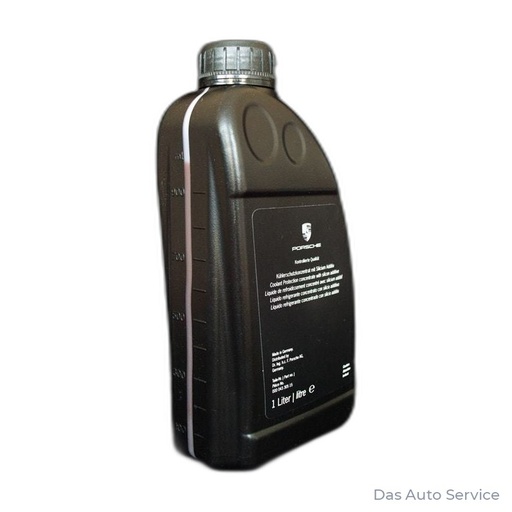
Genuine Porsche coolant with silicone additive 00040330515 1 l
Genuine Porsche coolant concentrate for models built after 1998. Dilute it with distilled water.
View in our shopRead more
- Routine servicing at Das Auto Service
- Diagnostics
- Service intervals for transverse-engine platforms (Golf, Passat…)
- When should I fit winter tyres, and how should I store my summer tyres?
- Hot engine and water: what not to do when your car overheats
- 1.8 and 2.0 TSI (EA888 Gen3): water pump and thermostat leaks
Frequently asked questions
Can I mix G12 and G13 coolant?
You can top up a system containing G12++ with G13. But never mix original G12 with G11. If you're not sure what's already in your car, it's better to replace all the coolant. I'm telling you this because one wrong top-up could leave you with an expensive repair bill.
What water should I use to dilute coolant?
Distilled water only. Tap water contains minerals that cause limescale to build up around the water pump and radiator. Trust me, you really don't want those problems.
What coolant concentration do I need for winter?
A 40% coolant concentration protects down to around -25 °C, while 50% protects down to around -36 °C. In Bulgaria, 40% is usually enough. But don't just guess. Check the concentration so you can get through winter without worrying.
How often should I change my coolant?
Every third heating season. Old coolant loses its protective properties and starts causing tiny pits in the aluminium engine block. And every autumn, between changes, check the freeze protection with a refractometer.